The Cybersecurity Workspace
Cloud Fortress is the platform a security team sees, decides and acts from. One place where the asset, the person, the vulnerability and the incident are the same conversation, not four consoles that never talk to each other.
Detection is not the problem. Everything that happens next is.
An average SOC lives with around ten tools: EDR, vulnerability scanner, intelligence feeds, identity manager, spreadsheets, tickets. Each one sees a slice of the attack and none sees the whole incident. The analyst becomes the human glue: copy from one console, paste into another, rebuild by hand the context the machines already had separately.
- Fragmented context
The «who» and the «what» live apart
The EDR knows which endpoint is compromised. The inventory knows whose it is and what it is used for. Nobody puts the two together at the moment it matters.
- Invisible work
Hours spent pasting, not deciding
Response time goes into tabulating, not containing. It is work that shows up in no KPI and gets paid for in exposure window.
- Slow decisions
Prioritising blind
Without knowing whether a critical CVE hits a test server or the ERP, everything looks urgent. And when everything is urgent, nothing is.
We don't replace your stack. We finally get it talking.
Cloud Fortress does not ask you to throw away what already works. Your EDR, your scanner and your feeds stay; we connect them into a shared platform where every signal lands on the same asset, the same owner and the same history. No rip and replace. The first integration is built around what the customer actually needs, not around a closed list of logos.
| How the work goes today | With Cloud Fortress |
|---|---|
| One console per tool; a person rebuilds the context | One platform where the context arrives already cross-referenced |
| The vulnerability is a row in a spreadsheet with no owner | The vulnerability hangs off the asset and off whoever answers for it |
| Priority comes from the scanner's score | Priority comes from exposure and the asset's business value |
| Answering «what do we have?» means asking three teams | A live inventory of assets, people, software and licences |
One decision, not four screens
The heart of Cloud Fortress is correlation: turning loose signals into a single story. This is what that looks like underneath.
Everything hangs off the asset
Every server, endpoint, domain, account or piece of software enters a live inventory with its owner and its criticality.
Signals land on it
A CVE, a leaked credential or an alert does not arrive as anonymous events: they arrive attached to the asset and to the person who answers for it.
Priority comes with context
Criticality is worked out from real exposure and business value, not from CVSS alone. What actually matters rises to the top.
You act, and it is on the record
The remediation task opens, gets followed to closure, and the whole trail stays auditable: for compliance and for the next incident.
- Asset
- Person
- Vulnerability
- Incident
A shared Core and three capability packs
On top of a common base with inventory, alerts, vCISO and dashboards, you switch on only the packs your organisation needs.
- Pack 1
Digital risk and brand
What goes on outside your perimeter: brand impersonation, leaks and credentials on the dark web, threat intelligence.
See the pack - Pack 2
Vulnerabilities and defence
The SOC's day-to-day: vulnerabilities with asset context, monitoring, incidents, threat hunting and account governance.
See the pack - Pack 3
Governance and compliance
ENS and ISO without the pain: living evidence, inventory compliance, regulatory templates and pentesting.
See the pack
Authority, without the smoke
We are a young company and we say so plainly: we are not going to show you customer logos we cannot publish yet, or badges we do not hold yet. Our credibility sits somewhere else.
- The product
You can see it running
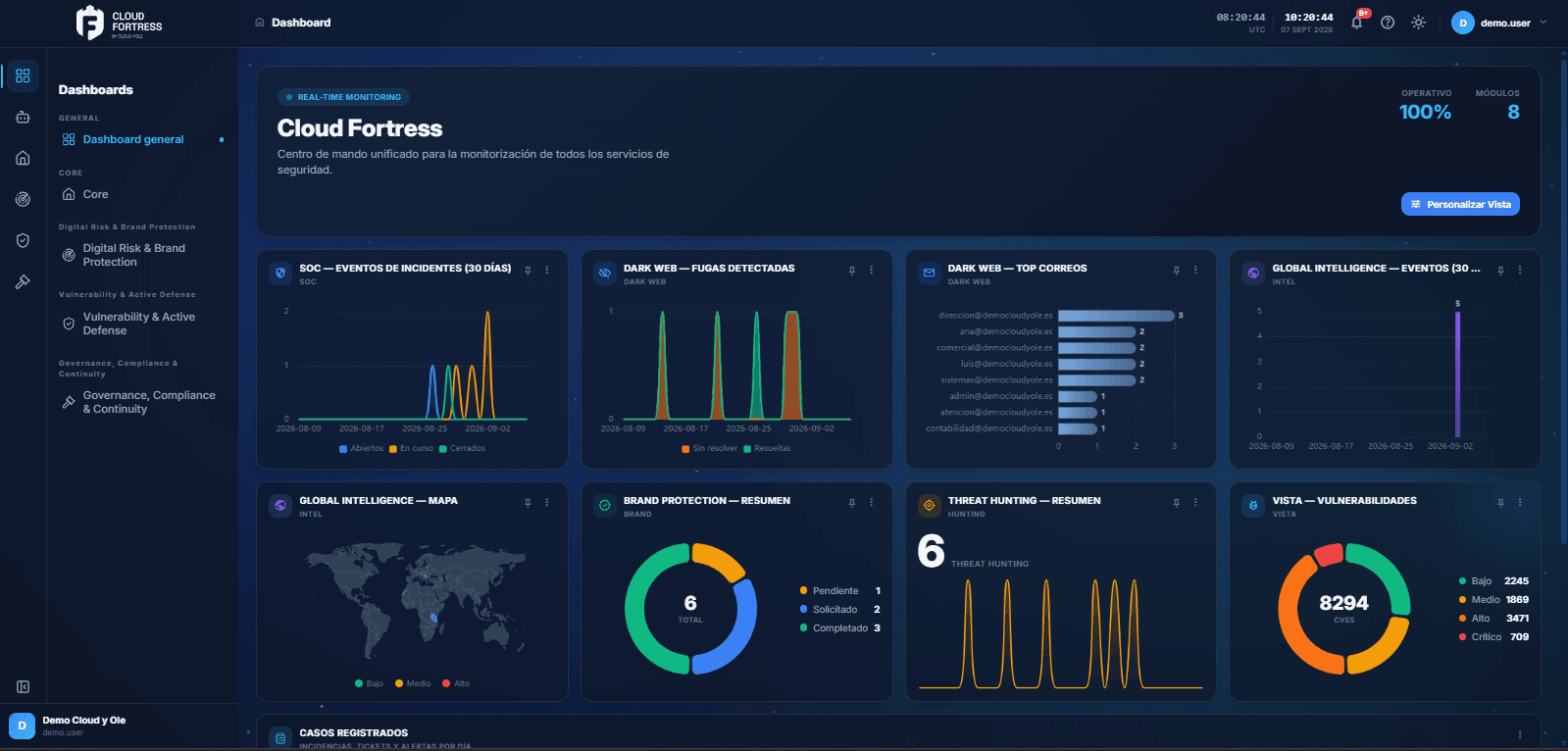
Real screenshots of the platform, not mock-ups. What we show is what there is.
- The team
Made in Málaga
Cloud Fortress is the product of Cloud y Olé, a cybersecurity company based at the Andalusia Technology Park.
Meet us - In the open
We explain the «how»
We show how it works underneath. Transparency is part of the product.
What everyone asks first
Do I have to replace my EDR or my SIEM?
No. Cloud Fortress builds on what you already have and puts it in context. The proposition is to integrate rather than replace.
Is this a SOAR, an XDR, a GRC?
It is a platform that gathers pieces of all of those around the asset. Rather than fit it into an acronym, we would rather show it to you running in a demo.
What size of team is it for?
For security teams that lose time hopping between tools today: from a CISO who carries it almost alone to a SOC running shifts.
How much does it cost?
The price fits your organisation and the packs you switch on. We go through it in the demo: no shop-window pricing.
How does my data get into Cloud Fortress?
Three ways, depending on the data: an agent deployed on the endpoints reports their inventory and status automatically; identities sync with your cloud identity provider; and everything else accepts bulk file upload or manual entry. The specific connections to your tools are agreed with you during onboarding.
What do I see of a pack I have not subscribed to?
You see it running with demonstration data, with a notice telling you that what you are looking at is a sample. It is not hidden behind a padlock. No action taken in that sample is ever actually sent out. It is the most honest way for you to decide whether it works for you before you buy it.
Can I control who sees what inside my team?
Yes, and with two independent keys: what your organisation has contracted, and the level you give each role. There are six levels, from «hidden» to «full», and the larger modules split the level by section: you can give your systems engineer full control over endpoints and read-only over the cryptographic inventory.
Is my organisation's data mixed with other customers'?
No. Isolation per organisation is a property of the real-time channel: one customer never receives another's events. And inside your organisation, events from a module a person's role does not reach are discarded before they get near their screen.
What languages is the platform available in?
Spanish, English, French and German, all complete. The language is stored on each person's profile, so it travels with them to any device. There is a light and a dark theme, and the employee portal is branded with your organisation's logo and welcome message.
Cloud Fortress by role
Understand the risk. Act with confidence.
Stop hopping between screens. See your security from a single place.