vCISO: leadership judgement, without the full-time post
Many organisations have capable people running security but nobody with the time or the mandate to lead it. The vCISO fills that gap, grounded in the data the platform already holds.
The gap between «doing security» and «leading it»
A CISO (Chief Information Security Officer) is the person who puts strategy behind cybersecurity: which risks are accepted, which are mitigated, in what order and with what budget. Many organisations have capable people running security but nobody with the time or the mandate to lead it, and without that layer the team firefights without ever advancing. Hiring a full-time CISO is not always viable or proportionate.
The vCISO (virtual CISO) fills that gap: it brings leadership judgement flexibly, so security decisions are made with a strategic head rather than only with operational urgency.
Strategy grounded in real data
The Cloud Fortress vCISO does not work on impressions: it rests on what the platform already knows about inventory, prioritised vulnerabilities, compliance status and incidents. That makes security leadership evidence-based: ordered risks, clear priorities and a roadmap the committee understands, fed by real operations rather than by a snapshot six months old.
Cross-references with
Frequently asked questions
Is the vCISO a person or a platform function?
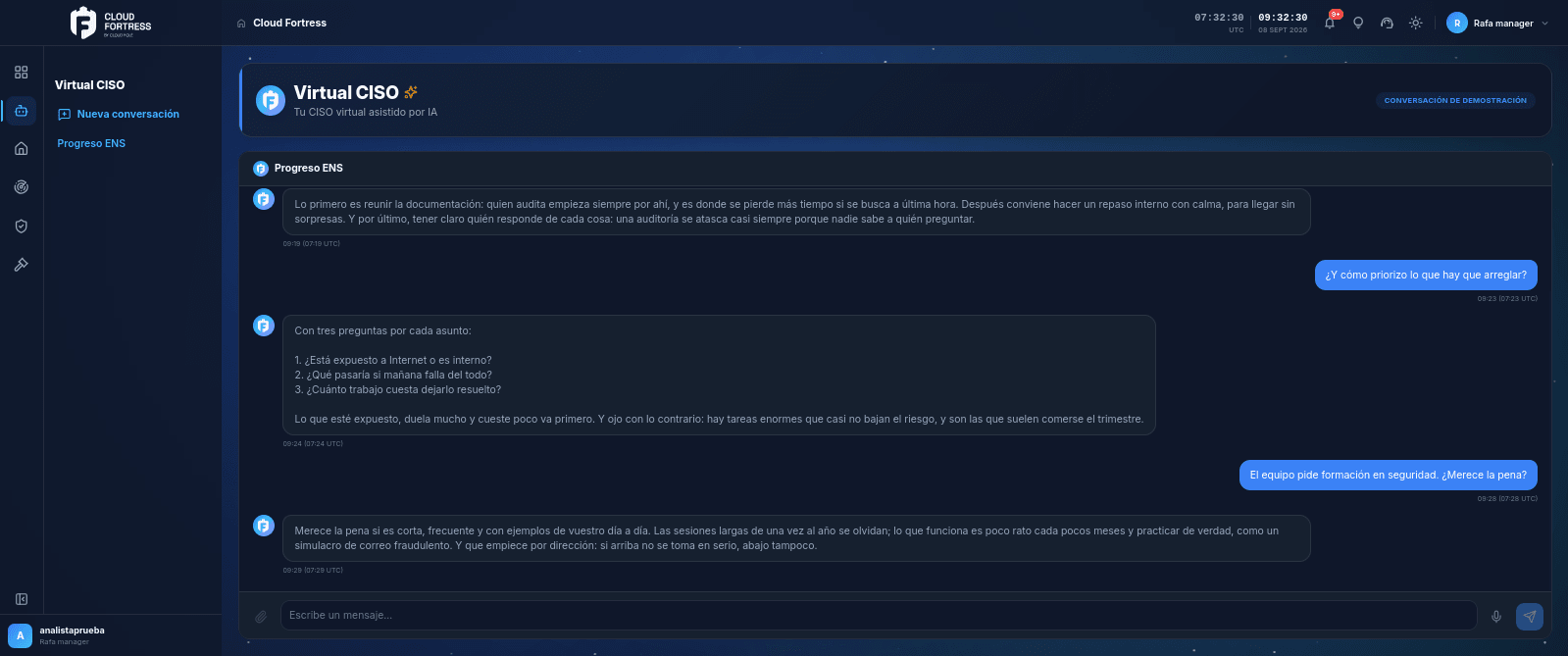
A platform function: an adviser available around the clock that you ask in plain language and that knows your organisation in depth. It is not a chatbot wired to a folder of documents; it is integrated with every module: endpoints, software, keys, vulnerabilities, open incidents, compliance status, leaks and expiring licences.
Is it included or purchased separately?
Included. The vCISO is part of the Core, so every customer has it from day one regardless of which packs they switch on.
Can it do things for me, or only answer?
Both. Asking questions is the baseline, and which actions it can carry out for the user is configured per organisation. Either way they respect the permissions of whoever is asking: the vCISO cannot do anything that person could not do by hand, and actions are confirmed on screen before being applied.
Does my data go out to an AI provider?
Only if you want it to. The organisation chooses the model: a commercial provider, or an AI of your own deployed in your infrastructure so the data never leaves it. It is a configuration decision, not a product limitation.
How is this different from pasting my data into a generic AI?
The shared context. A generic AI can only reason over what you paste into the prompt; here it reasons over the whole organisation, with the relationships between assets, people and cases already established. That correlation cannot be reproduced by copying and pasting.
Does it replace an in-house CISO?
It covers the gap when there is none, and amplifies one when there is, taking away the work of gathering data so they can focus on deciding.
See it running with your data in front of you
30 minutes with a scenario close to yours. No canned deck, no strings attached.