SOC monitoring where every alert arrives with context
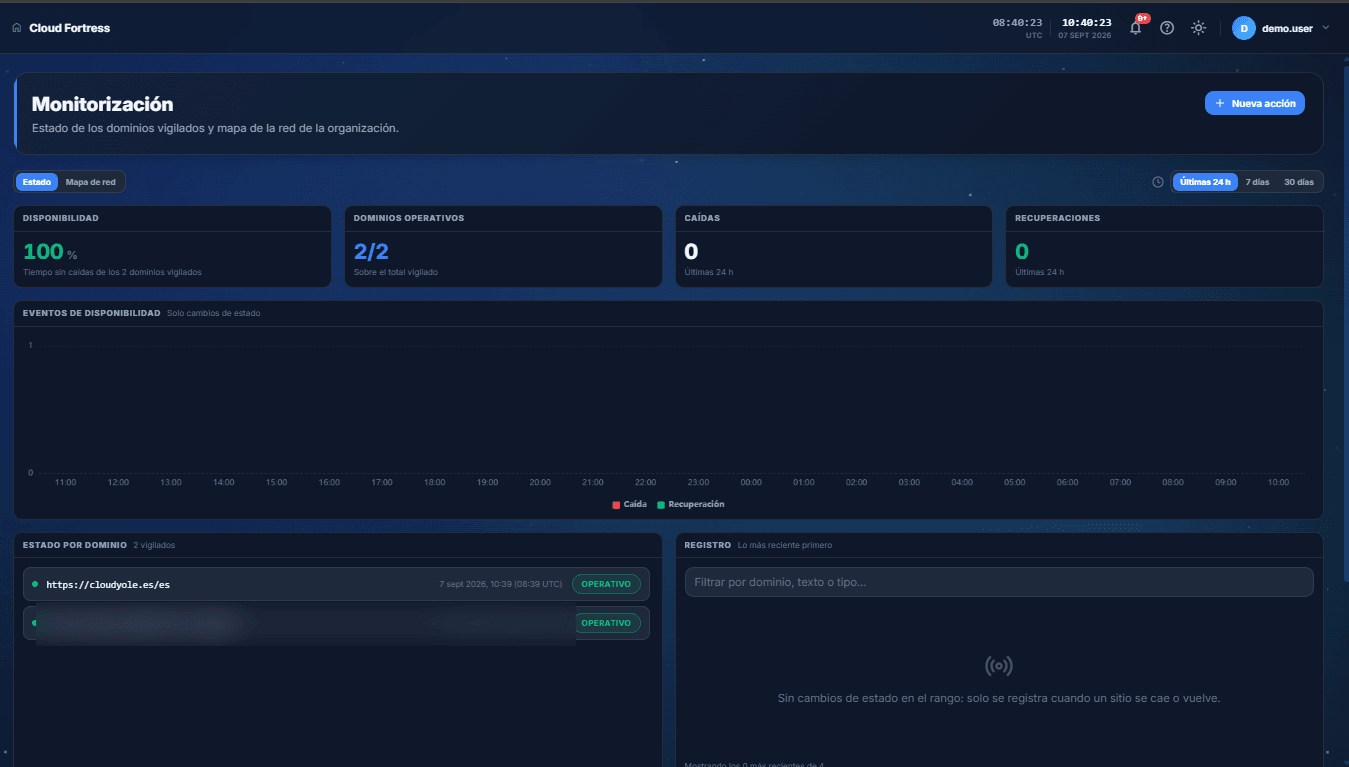
A SOC's silent enemy is not a shortage of data but its dispersion. Here the alert does not arrive as an anonymous event: it arrives linked to its asset, its owner and everything already known about it.
The hidden cost of switching screens
A SOC (Security Operations Centre) is the team and the set of tools that watch your organisation continuously to detect and respond to incidents. Monitoring is its heartbeat: gathering signals from everywhere and turning them into actions. A SOC's silent enemy is not a shortage of data but its dispersion: alert fatigue, and the time lost hopping between consoles to understand a single one.
Every jump between tools costs minutes and concentration. Multiplied by hundreds of alerts a day, that invisible cost is paid where it hurts most: in the window between something happening and somebody acting.
Watch and respond in the same place
Cloud Fortress brings monitoring and incident management into the same platform where the inventory lives. When an alert fires it does not arrive as an anonymous event: it arrives already linked to the affected asset, to its owner and to what is known about it: vulnerabilities, leaked credentials, previous incidents. The analyst stops rebuilding and starts deciding.
Collect
Signals from your sources in a continuous flow.
Contextualise
Each alert attaches itself to its asset and its history automatically.
Sort
Prioritisation lifts what is relevant and sinks repeated noise.
Respond
The incident is managed to closure without leaving the Workspace.
Cross-references with
Frequently asked questions
Is it a SIEM?
It brings together monitoring and response functions around the asset. Rather than fit it into an acronym, we would rather show it to you running in a demo.
Does it work if I do not have a formal SOC?
Yes. Many organisations do not have a SOC running shifts; handing them the context already assembled is precisely what lets them operate with fewer hands.
What can be linked to an incident?
Six classes of entity, with a selector common to the whole platform: endpoints, people, groups, cryptographic keys, software and vulnerabilities. All from the real inventory, so an incident's scope is read over assets that exist rather than over a list of names in a document.
Do I have to reload to see the latest?
No. A message in the incident chat, a status change, a new alert or a probe verdict appear on their own. Synchronisations that move thousands of rows are batched so the screen does not turn into a flicker.
How is each incident identified?
With a case code in the form MODULE-YEAR-XXXX, generated by the server. It is the same one the Cloud Fortress analyst sees, so quoting it in an email or a call is enough for both sides to be talking about the same case.
See it running with your data in front of you
30 minutes with a scenario close to yours. No canned deck, no strings attached.