Brand protection: hunt whoever is passing themselves off as you
An attacker does not need to get into your network to use your name. Registering a lookalike domain and cloning your login portal is enough. The sooner you spot it, the fewer people fall for it.
Your brand is an attack vector
Brand protection watches the fraudulent use of your identity outside your perimeter: domains that mimic yours with one letter changed (typosquatting), fake social profiles, cloned websites for phishing, or unauthorised changes to your pages (defacement). You do not take the damage directly on your servers; your customers and your reputation do, and it ends up being your incident.
An attacker does not need to get into your network to use your name. Registering a lookalike domain and standing up a copy of your login portal is enough. The sooner you detect it, the fewer people fall for it and the sooner you can request removal.
Detect, evidence, take down
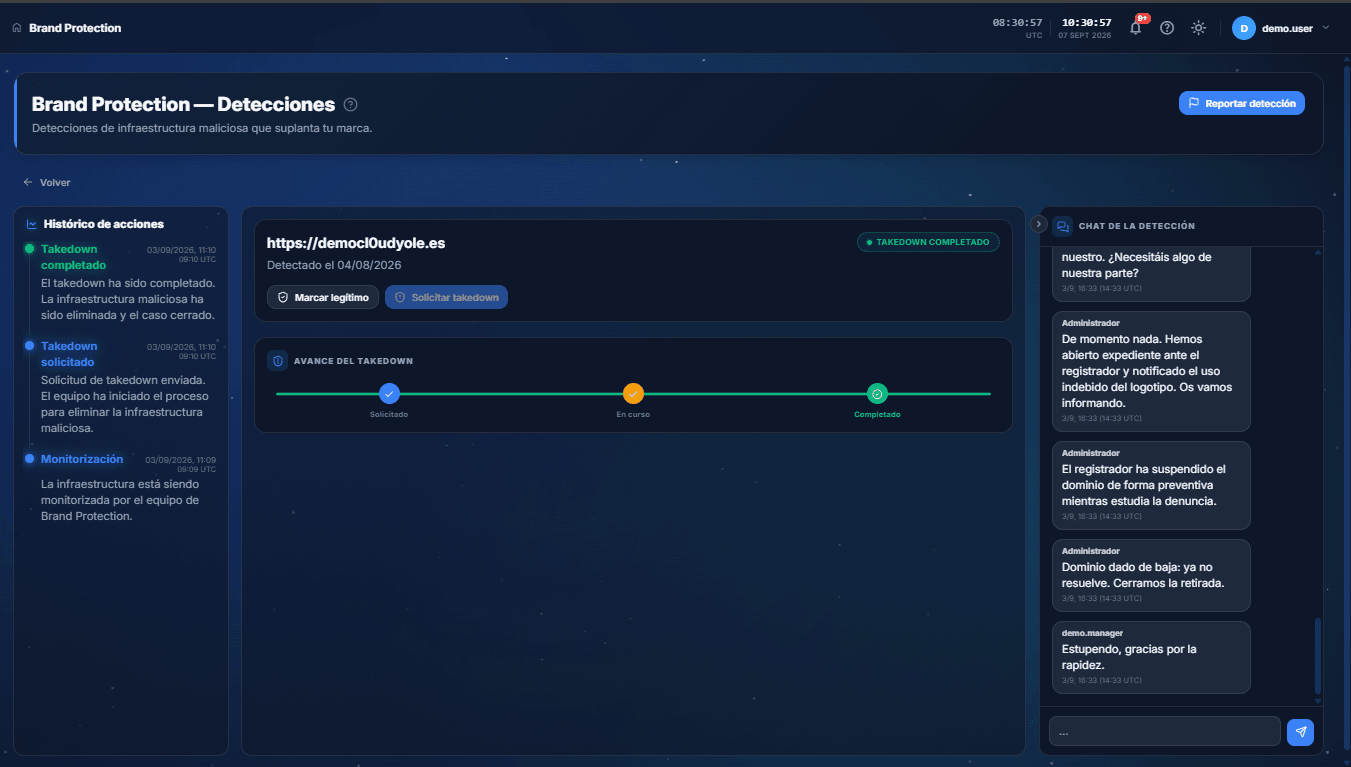
Cloud Fortress continuously tracks the appearance of impersonations and alterations, and when it finds one it does not stop at the notice: it gathers the evidence needed to file the takedown and, this is what sets it apart, links it to the rest of your risk context, in case that campaign comes with leaked credentials or suspicious activity on your assets.
Cross-references with
Frequently asked questions
What is a takedown?
The request to remove fraudulent content, such as a domain or a cloned site, from whoever hosts or registers it. Cloud Fortress prepares the case with the evidence.
Does it also detect defacement of my sites?
Yes: unauthorised changes to your pages, so you find out before your customers do. You add the domain or URL from the panel and the probe handles the rest.
Who decides whether a change to the site is legitimate?
You do. The probe detects the change and shows the exact difference; the verdict, legitimate or not, is the organisation's, and the people who contribute most are usually whoever maintains the site, because they know whether the change was theirs. If it is illegitimate, a pre-written SOC incident opens in one click.
What do I need to get started?
Add the organisation's domain. From there the monitoring service tracks the appearance of domains and profiles that mimic your brand; nothing needs deploying in your infrastructure.
Is this uptime monitoring?
No, it is a different thing. Monitoring tells you whether your site is down; this tells you whether your site is up and serving content you did not put there. Those are the attacks that take longest to detect, precisely because everything looks fine.
See it running with your data in front of you
30 minutes with a scenario close to yours. No canned deck, no strings attached.